
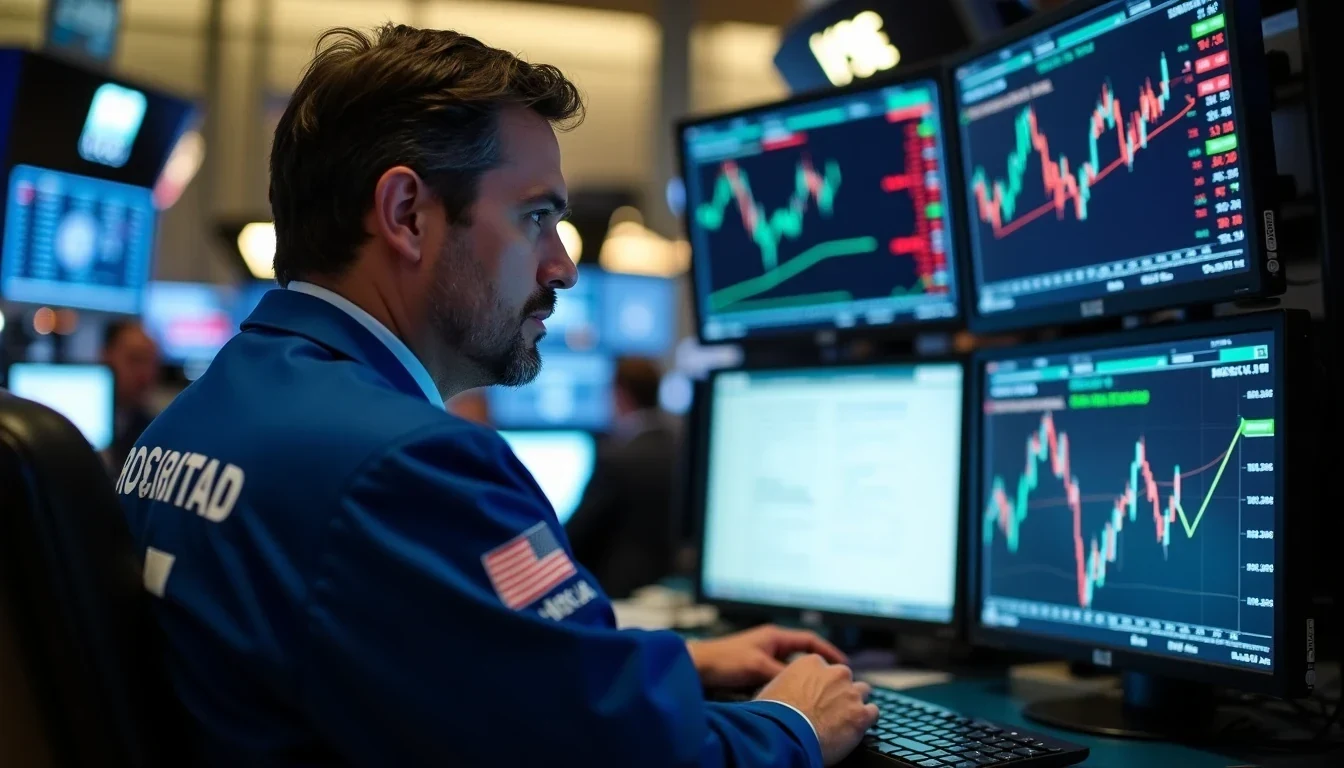
One trillion dollars evaporated from Wall Street in a single trading session, and the message was unmistakable: the AI trade has run out of patience for promises. For two years, capital poured into anything connected to artificial intelligence with the velocity of a gold rush, rewarding companies that spent faster than they could explain why. That bargain expired in October. The Nasdaq Composite shed 2.9%, the S&P 500 lost 1.8%, and the Nasdaq-100 cratered roughly 3.5%, its worst day since June. The technology had not changed, but the arithmetic had. Investors stopped asking how large AI could grow and started demanding to know when the cash would arrive.
The bill came due for Intel first
Intel’s 28.6% collapse on a single day, its steepest since 1974, rewrote trading-floor vocabulary. Management delivered a profit outlook below expectations and warned that cash flow would stay under pressure. The quarterly revenue forecast missed Wall Street estimates by more than $1 billion. The market responded by erasing roughly $146 billion in market value, a figure that would constitute a mid-sized national economy.
The contagion moved through semiconductors with mechanical speed. AMD dropped 10.9%, Nvidia 4.2%, Broadcom roughly 5.5%, Micron about 5.3%, and the Philadelphia Semiconductor Index plunged 7.2%. Even Reddit, that peculiar barometer of retail sentiment, cratered around 29%. These were not isolated disappointments. They were a coordinated repricing of the entire infrastructure layer that feeds the AI buildout.
The monthly damage was severe enough to suggest something structural rather than cyclical. Nvidia finished October roughly 10% lower. AMD fell nearly 17.5% across the month. Intel lost more than 45%. The semiconductor index as a whole shed over 15%. These are not the marks of a routine pullback in a growth sector. They are the marks of capital reallocating away from a narrative it no longer fully believes.
The hyperscalers built a bonfire
Behind the supplier carnage sits a more fundamental question about the buyers. Microsoft, Meta, Amazon, and Alphabet have collectively absorbed more than one-third of all capital spending by S&P 500 companies over the past twelve months. That concentration is without precedent in modern corporate history. Four companies are deploying capital at a scale that reshapes global supply chains for semiconductors, power generation, and data center construction.
Amazon’s numbers illustrate the strain. The company burned roughly $42.4 billion in cash across the prior twelve months while property and equipment spending reached about $94.8 billion, with AI infrastructure the dominant driver. Free cash flow, that unglamorous metric that separates viable enterprises from expensive hobbies, fell sharply. A day earlier, Alphabet had suffered its worst stock-market day on record as investors fixated on the same combination: massive AI spending paired with weaker cash generation.
For most of the boom, Wall Street treated this spending as its own justification. More GPUs, more data centers, more power contracts, more networking capacity, more debt, more headcount. Each announcement of increased capex was met with higher multiples, as if the spending itself were the product. That logic required belief in a future where all this capacity monetized cleanly and quickly. The October selloff suggests the market has begun to doubt the timeline, if not the destination.
Valuations this extreme have no margin for error
The mechanism of this correction is worth understanding precisely. When a stock trades at multiples that assume transformational growth, good results become insufficient. The company must beat expectations, raise forward guidance, defend margins, and demonstrate that hundreds of billions in accumulated AI capital expenditure will eventually yield economic returns. Missing any element of this test can trigger the erasure of $100 billion or more in market value within hours.
Intel missed. Amazon’s cash flow disappointed. Alphabet’s spending spooked. The penalties were immediate and disproportionate because the starting valuations left no room for anything less than perfection.
This is the tyranny of extreme pricing. A company valued at twenty times revenue can sustain almost no friction. A company valued at forty times revenue, as several AI-adjacent names have been, requires reality to outperform imagination consistently. The October session demonstrated what happens when reality merely matches imagination instead.
The broader corporate picture does not suggest systemic collapse. Eighty-two percent of the 299 S&P 500 companies that had reported third-quarter results were beating analyst estimates. Aggregate earnings growth tracked around 31.6%. Corporate America is not disintegrating. The specific price investors will pay for AI-exposed future profits has changed, as has the evidentiary standard required to justify that price.
What this means for the infrastructure layer
Companies selling the physical components of AI, the so-called picks and shovels, built their valuations on an assumption of sustained explosive demand from hyperscalers. That assumption now faces its first serious test. If Amazon, Microsoft, Meta, and Alphabet slow their spending, or if financing costs rise further, or if monetization of AI applications takes longer than the roadmap suggests, the operating leverage that created enormous upside for suppliers reverses into equally enormous downside.
This is not theoretical. The Philadelphia Semiconductor Index’s 7.2% single-day drop and its more than 15% monthly decline are the market’s attempt to price that reversal in real time. Nvidia remains among the strongest businesses in the world by any operational metric, yet its stock lost roughly 10% in October. The gap between business quality and stock performance is the gap between what the company earns and what investors had projected it would earn.
For suppliers, the risk extends beyond immediate revenue. Production capacity, R&D pipelines, and hiring plans were calibrated to a demand curve that may now flatten. The capital intensity of semiconductor fabrication means misjudging demand by even two quarters can convert growth investments into stranded assets. Intel’s $146 billion value destruction is partly a verdict on its own execution, but it is also a signal that the market now questions the slope of demand growth that would have made its turnaround viable.
The rand investor’s vantage
South African capital watching this unfold should note the currency and rate asymmetry. The Federal Reserve’s trajectory directly conditions how cheaply American tech giants can finance their AI buildouts. If US financing costs stay elevated or rise further, Amazon’s $94.8 billion annual property and equipment spending alone becomes more expensive to sustain, and the pressure to show returns intensifies. For local investors with dollar-denominated tech exposure, the rand’s volatility against the dollar adds a separate layer of risk to an already uncertain position.
More strategically, the repricing creates a window to observe which AI applications are actually generating revenue versus which are still pilot projects dressed in press releases. The gap between announced AI initiatives and monetizable products is where the next round of value destruction will concentrate. South African institutional capital, which has flowed into global tech funds and directly into names like Nvidia, should be asking hard questions about that gap rather than assuming the October selloff was purely technical.
What is actually known and how to check
The core claims in this episode are verifiable from public filings and market data. Intel’s 28.6% drop and its revenue forecast miss are documented in its quarterly release. Amazon’s $42.4 billion cash burn and $94.8 billion property and equipment spending appear in its cash flow statement. Alphabet’s record stock decline is recoverable from price history. The aggregate S&P 500 earnings data comes from the ongoing quarterly reporting season.
What remains uncertain is the forward trajectory. The Nasdaq sits roughly 7.8% below its October 6 record close, close enough to formal correction territory that every subsequent earnings report, Federal Reserve signal, and AI capital expenditure update will move the index materially. The central question, unresolved, is whether this episode represents the healthy reset that allows the AI trade to continue on more sustainable valuations, or the first serious crack in the most expensive thematic trade in market history.
The answer will not come from technology reviews or product launches. It will come from cash flow statements, from whether the hundreds of billions in accumulated spending begin to convert into revenue that exceeds the cost of building and running these systems, and from whether hyperscaler management teams can articulate that conversion with specificity rather than aspiration. The market has spoken clearly about what it wants to hear. The coming quarters will reveal which companies have a response.