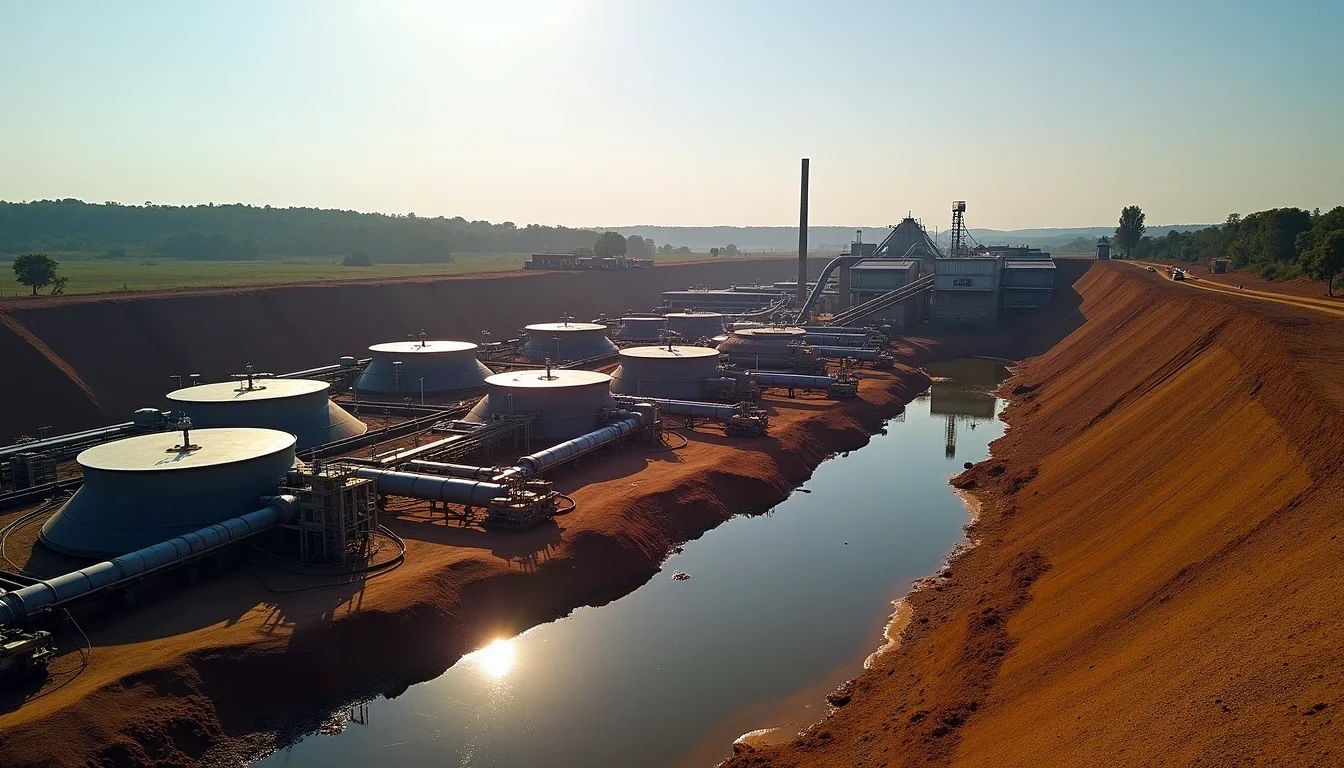
Zambia has spent decades shipping copper out of the ground and watching most of the money settle elsewhere. The $498 million tailings-leach plant now under construction in Chingola does not reverse that history, but it does mark a different kind of bet, that the waste already created contains enough value to justify one of the largest single processing investments on the continent. Konkola Copper Mines, the operator, has contracted China’s NERIN Engineering to build a facility designed to pull 70,000 tonnes of additional copper annually from material previously discarded as uneconomical. KCM calls it Africa’s largest plant of its kind. Reuters reported the deal independently. The numbers are specific enough to matter, and the location sits at the edge of a broader question about who profits from African minerals, and how.
Why Mine Waste Is Now Worth $498 Million
The Chingola plant will apply hydrometallurgical processing to tailings, the crushed rock and chemical residue left behind after decades of conventional extraction. The method is not exotic. Leaching with acid dissolves remaining copper minerals; solvent extraction isolates the metal; electrowinning plates it into pure cathodes. What has changed is the economics. Older processing left significant copper in waste piles because recovery rates were lower and commodity prices did not justify the chemistry. At current prices and with improved techniques, that same waste now supports a half-billion-dollar capital commitment.
NERIN Engineering’s involvement signals where the engineering capacity currently resides. The Chinese firm brings experience from a domestic mining sector that has long operated at scale. For Zambia, the transaction is straightforward in structure but complex in implication: foreign capital and expertise build domestic processing capacity, with output feeding global demand for electrification infrastructure, renewable energy hardware, and electric vehicle supply chains. The copper does not stay in Zambia. The processing margin, the skills transfer, and the industrial footprint do, at least in part.
The 70,000 tonne annual addition is modest against Zambia’s national target of 3 million tonnes by 2031, up from roughly 890,000 tonnes this year. But tailings projects carry advantages greenfield mines cannot match. Permitting is faster. Capital intensity is lower. Environmental disruption is confined to existing disturbed land rather than new terrain. For a country seeking to triple output in six years, these projects function as the reliable base load of expansion, complementing riskier new mine developments.
The Mathematics of Zambia’s Copper Ambition
The gap between 890,000 tonnes and 3 million tonnes is 2.11 million tonnes of additional annual production. Spread across six years, that requires compound growth exceeding 20 percent annually, a rate no major copper jurisdiction has sustained over that duration. The target is less a forecast than a statement of intent, a number designed to concentrate government effort and attract investment interest.
Tailings recovery contributes incrementally. At 70,000 tonnes, the Chingola plant accounts for roughly 3.3 percent of the required increase. Other tailings projects, expansions at existing operations like First Quantum’s Kansanshi and Sentinel mines, and potential new developments at projects such as Barrick’s Lumwana expansion would need to deliver the remainder. The arithmetic is demanding. The geology may cooperate; the capital markets and permitting timelines often do not.
What the target does achieve is positioning. Zambia’s government under President Hakainde Hichilema has made copper central to its economic diplomacy, using production forecasts to negotiate infrastructure financing, debt restructuring, and trade relationships. The 3 million tonne figure appears in discussions with the IMF, in bilateral meetings with Chinese state lenders, and in marketing to European automakers seeking supply chain security. Whether it materialises matters less immediately than whether it is believed long enough to unlock the capital required to approach it.
Who Else Is Reprocessing Waste
Zambia is not alone in this logic. South Africa’s gold sector has operated tailings reprocessing at scale for years. DRDGold, spun from Durban Roodepoort Deep, built its entire business model on recovering gold from historic mine waste on the Witwatersrand, using modern flotation and leaching to extract ounces unrecoverable with 1980s technology. Sibanye-Stillwater operates similar PGM recovery from tailings. The environmental remediation is genuine; the profit motive is primary.
In Ghana, several gold producers have begun reprocessing older tailings with carbon-in-leach circuits that achieve recoveries impossible when the material was first deposited. Zimbabwe has evaluated PGM and gold dump reprocessing, though capital constraints have slowed implementation. The Democratic Republic of Congo, dominated by copper-cobalt primary extraction, has seen growing interest in historical tailings as cobalt prices for battery applications have elevated the value of previously marginal material.
The pattern is consistent across jurisdictions: higher prices and better technology convert waste into ore. The environmental benefits, real as they are, follow from the economics rather than driving them. Much coverage of tailings projects frames them as sustainability initiatives. They are not. They are margin extraction operations that happen to clean up previous environmental damage as a side effect.
What China Gets From Building Processing Capacity
NERIN Engineering’s role in the Chingola project fits a broader Chinese strategy in African mining that has shifted over the past decade. Early engagement focused on offtake: securing raw concentrate for smelters in China. More recent investments emphasise processing capacity located at source, a response to both logistical costs and growing African government insistence on domestic beneficiation.
For Chinese firms, building plants in Zambia reduces shipping volumes of low-grade concentrate, lowers exposure to African infrastructure bottlenecks on export routes, and establishes operational footholds that can expand as projects prove viable. The technology transfer is real but bounded. Chinese engineering firms typically retain process design and critical equipment supply, with local content requirements met through construction labour and non-specialised services. The skills gradient is steep enough that Zambian engineers will require years of operational exposure before independently replicating such facilities.
The debt implications deserve attention. The $498 million figure has not been publicly broken down between equity, debt, and potential sovereign guarantees. Chinese mining finance in Africa has historically combined commercial loans with policy bank lending in proportions that obscure true cost of capital. Zambian government disclosure on terms has improved under the Hichilema administration following the debt restructuring concluded in 2024, but specific project financing remains opaque. For readers tracking capital flows, the relevant question is not whether the plant gets built, but whether Zambia’s treasury carries contingent liability if copper prices disappoint.
Building Something That Lasts
Copper demand projections for electrification are robust but not certain. Battery chemistry shifts toward lithium-iron-phosphate reduce per-vehicle copper intensity. Aluminium substitution in power cabling progresses slowly but persistently. Recycling rates for copper scrap, already high in developed economies, will rise further as end-of-life vehicles and infrastructure enter waste streams. These factors do not eliminate demand growth but they complicate it, introducing downside scenarios that mine planners rarely foreground.
Zambia’s strategic value lies in geological endowment and political geography rather than processing sophistication. It is landlocked, dependent on export routes through Tanzania or South Africa, and historically volatile in policy treatment of mining investors. The 3 million tonne target assumes these constraints ease rather than tighten. The Chingola tailings plant, by utilising existing infrastructure and waste, partially sidesteps them.
What would constitute genuine success? Not merely the 70,000 tonnes of copper produced, but whether the operation trains Zambian metallurgists who subsequently design or manage similar facilities without Chinese engineering contracts. Whether the processing chemistry is adapted to other Zambian waste streams. Whether the revenue flows strengthen fiscal capacity rather than disappearing into operational costs and debt service. These are the metrics that determine whether the $498 million builds industrial capacity or merely relocates a processing step from China to Chingola.
The plant will operate for decades if the geology and economics cooperate. Africa’s mining history is littered with projects that delivered output without development, extraction without transformation. The tailings-leach technology is proven. The capital is committed. The remaining variable is whether Zambia’s institutions can convert a single facility into a sustained competitive advantage in copper processing. That conversion has not happened yet anywhere on the continent at scale. The bet is that Chingola becomes the exception.